You choose a class marked beginner, press play, and discover that the first few transitions move faster than expected. A difficulty label can help you narrow your options, but it cannot describe every pose or predict exactly how a session will feel. Treat it as a starting point, then use the practice instructions to make a more informed choice.
Read beyond the level
Check whether the class description mentions standing sequences, balance poses, longer holds, or repeated transitions. Those details can tell you more about what you will be following than a single level word. If the instructions name props or pose variations, note them before the video begins so you can set up without interrupting the practice.
Also consider the class duration and yoga style. A longer video may include more time to work through a sequence, while a shorter class may move at a brisker pace to fit its focus; neither is guaranteed. The description and opening guidance are the best places to check what this particular class includes.
Set up for clear choices
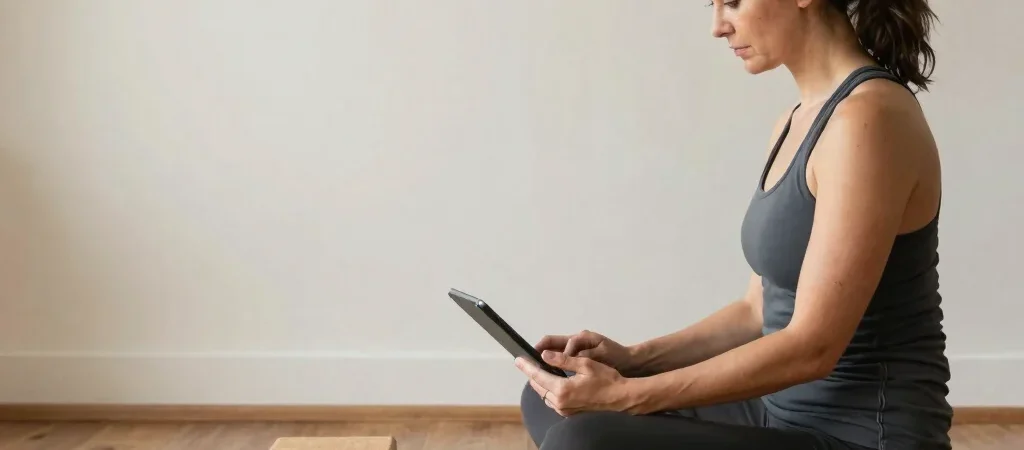
Place your mat where you can see the screen without twisting to follow the instructor. Keep any listed props within reach, and leave enough clear floor space for a lunge or a wide-legged stance. These small choices make it easier to listen and adjust rather than scrambling for a block mid-sequence.
During the video, use the instructor's options and pause when you need time to understand a transition. You do not have to match every movement at the same moment as the screen. If a pose feels unclear or unsuitable for you, step out of it and follow an option you understand.
Choose the class you can follow
Difficulty is not a score to work your way through; it is one detail among several that helps you choose a class. Compare the level with the instructions, style, and duration, then pick the video that feels understandable from its description. A good first choice is the class you can follow attentively, with enough room to make your own adjustments.